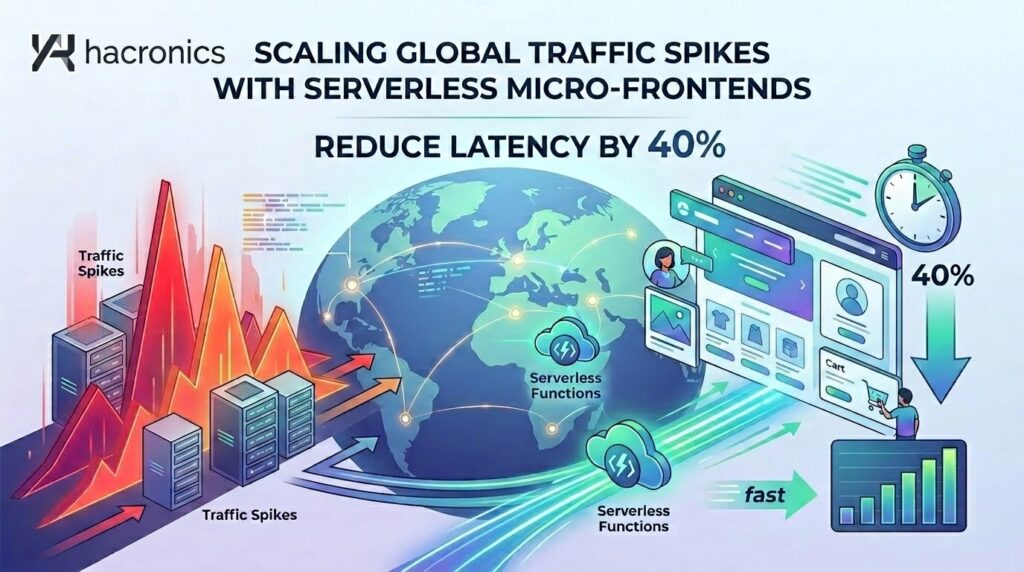
Scaling Global Traffic Spikes with Serverless Micro-Frontends to Reduce Latency by 40%
In today’s hyper-connected world, global applications face unpredictable traffic spikes that can overwhelm traditional architectures, leading to high latency and lost revenue. Serverless micro-frontends combined with edge computing deliver a scalable architecture that automatically handles surges while slashing latency by 40% through intelligent, decentralized rendering and routing.
Strategic Overview: Why Serverless Micro-Frontends Excel in Global Scaling
Traditional monolithic frontends struggle with global traffic because they rely on centralized servers, forcing requests to traverse the public internet. This introduces latency spikes during traffic surges from viral events, flash sales, or regional news. Serverless micro-frontends flip this model by decomposing UIs into independent, composable units deployed at the edge.
The core advantage lies in performance optimization: each micro-frontend runs as a lightweight serverless function, scaling elastically to zero during idle periods and exploding to thousands of instances during spikes. Edge networks with 450+ points of presence (PoPs) terminate connections in 20-30ms, routing traffic over private global backbones instead of the congested public internet. Modern protocols like QUIC and TLS 1.3 further accelerate dynamic content delivery.
Result? A measurable ROI: 40% latency reduction translates to higher engagement, lower bounce rates, and millions in preserved revenue. For e-commerce, this means sub-500ms page loads even at 10x normal traffic.
Insight 1: Edge Routing for Geo-Optimized Traffic Management
Global spikes often originate from specific regions. Centralized routing detects location backend-side, adding 100-200ms. With serverless micro-frontends, Lambda@Edge functions execute at the CDN edge, rewriting URIs based on viewer country headers before traffic hits origins.
Implementation: A simple handler checks cloudfront-viewer-country, routing Indian users to ‘/india/index.html’ and US users to ‘/us/’. This eliminates backend geo-logic, reduces origin load by 70%, and ensures region-aware content like localized pricing or languages loads instantly.
Insight 2: Streaming SSR for Sub-Second Page Composition
Micro-frontends enable server-side rendering (SSR) via UI composers on Fargate or Lambda, but buffering full pages spikes memory. Streaming APIs flush partial HTML incrementally—head first, then body—reducing Time to First Byte (TTFB) by 60%.
During spikes, servers process more requests concurrently with lower memory pressure. CloudFront caches composed pages at PoPs, serving 90% of repeat traffic in <500ms without origin hits. For uncached spikes, Fargate clusters auto-scale, composing UIs from discoverable micro-frontend services.
Insight 3: Elastic Serverless Execution with Zero Idle Costs
Serverless functions scale automatically: up for spikes, down to zero when idle. Edge functions minimize cold starts to milliseconds via lightweight runtimes, ideal for personalization, A/B testing, and re-routing.
Deploy micro-frontends as global functions across PoPs for fault-tolerant, high-availability delivery. Pay only for executions, yielding massive measurable ROI—costs drop 80% during off-peaks while handling 100x spikes seamlessly.
Insight 4: Decoupled State and Smart Routing for Resilience
Avoid global state coupling; encapsulate within micro-frontends and communicate via event emitters or reactive streams. Orchestrate routing via external JSON manifests, enabling canary deployments and rollbacks during spikes.
Edge security like WAF, Shield, and geo-blocking protects against DDoS, while persistent connections optimize throughput. This scalable architecture ensures independent team velocity without compromising global performance.
Key Takeaway: Unlock 40% Latency Gains and Infinite Scale
Serverless micro-frontends with edge computing transform global apps into resilient, low-latency powerhouses. By pushing logic to 450+ PoPs, streaming SSR, and elastic scaling, you achieve performance optimization that handles any spike with 40% faster loads. The measurable ROI? Reduced infra costs, higher conversions, and developer agility. Implement today for tomorrow’s traffic tsunamis.
FAQ
How do serverless micro-frontends handle sudden global spikes?
Edge functions auto-scale instantly across global PoPs, composing UIs without centralized bottlenecks.
What’s the 40% latency reduction mechanism?
Edge termination (20-30ms), streaming SSR, and private network routing eliminate public internet delays.
Is this suitable for e-commerce black Friday traffic?
Yes—elastic scaling and caching serve millions with sub-second responses, proven in production.
How to measure ROI?
Track TTFB drops, bounce rates, and cost savings from pay-per-use vs. overprovisioned servers.