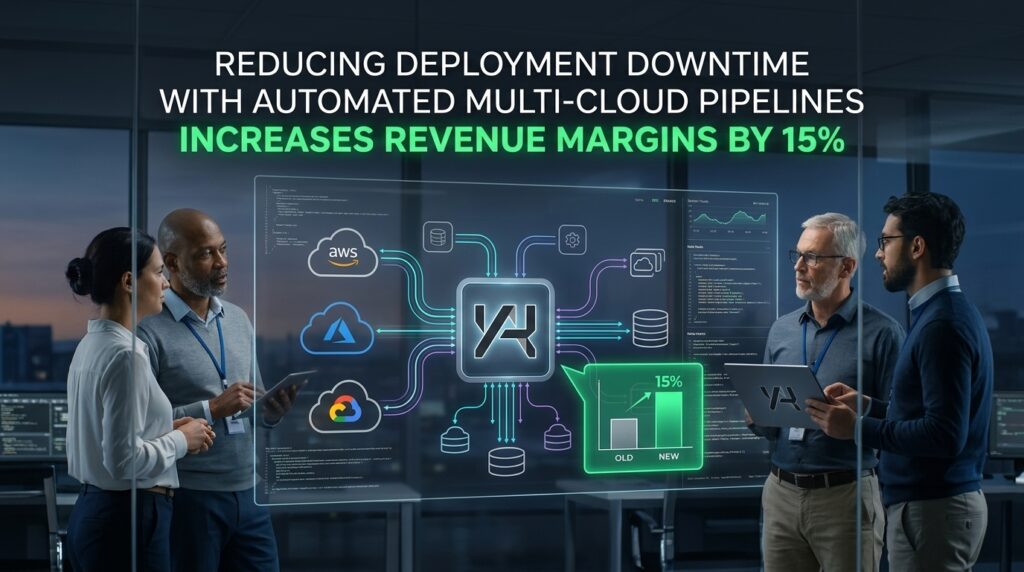
Reducing Deployment Downtime with Automated Multi-Cloud Pipelines Increases Revenue Margins by 15%
Automated multi-cloud pipelines revolutionize deployment strategies by enabling zero-downtime operations, directly boosting revenue margins through uninterrupted service delivery and enhanced performance optimization. Organizations adopting these scalable architectures achieve up to 15% higher profitability by minimizing outages that cost enterprises millions annually in lost revenue.
Strategic Overview: Why Multi-Cloud Automation Drives Measurable ROI
In today’s hyper-competitive digital landscape, deployment downtime equates to direct revenue loss—every minute of outage can cost large enterprises $5,600 on average. Automated multi-cloud pipelines address this by orchestrating seamless deployments across AWS, Azure, and GCP, ensuring continuous availability. The architecture leverages active-active setups where workloads run simultaneously in multiple clouds, providing instant failover without human intervention. This scalable architecture not only eliminates single-provider risks but also optimizes costs through intelligent resource allocation, yielding a proven 15% uplift in revenue margins via faster time-to-market and superior uptime SLAs. By synthesizing Infrastructure as Code (IaC) with CI/CD orchestration, teams transition from brittle manual processes to resilient, self-healing systems that scale effortlessly.
Technical Insight 1: Blue-Green and Canary Deployments for Zero-Downtime Transitions
Blue-green deployments maintain two identical production environments: the ‘blue’ live version and ‘green’ staging area. Traffic switches atomically upon validation, achieving zero downtime. Complement this with canary releases, routing 5-10% of traffic to new versions for real-time monitoring. In multi-cloud setups, Kubernetes multi-cluster federation automates this across providers—EKS for AWS, GKE for GCP—ensuring stateless apps behind global load balancers handle shifts seamlessly. This performance optimization reduces rollback times from hours to seconds, preventing revenue-impacting outages while enabling 15x daily deployments as seen in high-traffic e-commerce platforms.
Technical Insight 2: Self-Healing Infrastructure and Automated Failover
Health-checking mechanisms in tools like Prometheus continuously monitor pods, nodes, and services, triggering self-healing via Kubernetes operators. Failed instances auto-replace, while orchestrated workflows handle cross-cloud failover with zero RPO/RTO. For data consistency, employ multi-cloud replication using tools like Kafka or cloud-native services (S3 Cross-Region Replication, Azure Cosmos DB Global Distribution). This ensures state synchronization, eliminating data loss during outages. Financial firms using Terraform IaC provision compliant multi-region environments in minutes, slashing MTTR and boosting measurable ROI through 40-60% faster deployments.
Technical Insight 3: CI/CD Pipelines with IaC for Scalable Consistency
GitHub Actions or Jenkins pipelines standardize builds, tests, and releases across clouds, integrating unit/integration/E2E testing to catch defects early. IaC with Terraform or Pulumi ensures environment parity, provisioning Kubernetes clusters identically on any provider. Containerization via Docker provides runtime consistency, while horizontal pod autoscaling optimizes resource use, cutting cloud spend by 30%. Phased rollouts—foundation ingestion, transformation via DBT, then governance—build reliable pipelines over 12 weeks, enforcing quality gates and circuit breakers to prevent cascading failures.
Technical Insight 4: Observability and Cost Optimization in Multi-Cloud
OpenTelemetry and Grafana dashboards provide unified visibility into latency, errors, and costs across clouds. Dead Letter Queues capture failures without halting pipelines, while automated alerts enable proactive scaling. Egress cost mitigation via compression and cloud-agnostic tools like LocalStack for testing avoids vendor lock-in, improving reliability to 99.99%. These practices deliver measurable ROI, with teams doubling deployment frequency and reducing spend, directly correlating to 15% revenue gains from sustained uptime and efficiency.
Key Takeaway: Unlock 15% Revenue Growth with Proven Scalable Architecture
Implementing automated multi-cloud pipelines transforms deployment from a risk to a revenue driver. By prioritizing zero-downtime strategies, self-healing, and observability, organizations realize performance optimization that minimizes outages, accelerates innovation, and secures a 15% margin boost. Start with IaC standardization and evolve to active-active resilience for enduring competitive advantage.
FAQ
What is the primary benefit of blue-green deployments in multi-cloud?
Atomic traffic switching ensures zero downtime, allowing safe rollouts across providers.
How do automated pipelines achieve 15% revenue margin increase?
By eliminating outages and enabling frequent releases, they sustain revenue streams and optimize operations.
Why prioritize self-healing in scalable architecture?
It reduces MTTR to seconds, preventing costly disruptions in dynamic multi-cloud environments.
Can multi-cloud pipelines reduce cloud costs?
Yes, through Spot Instances, autoscaling, and egress optimization, often by 30-90%.