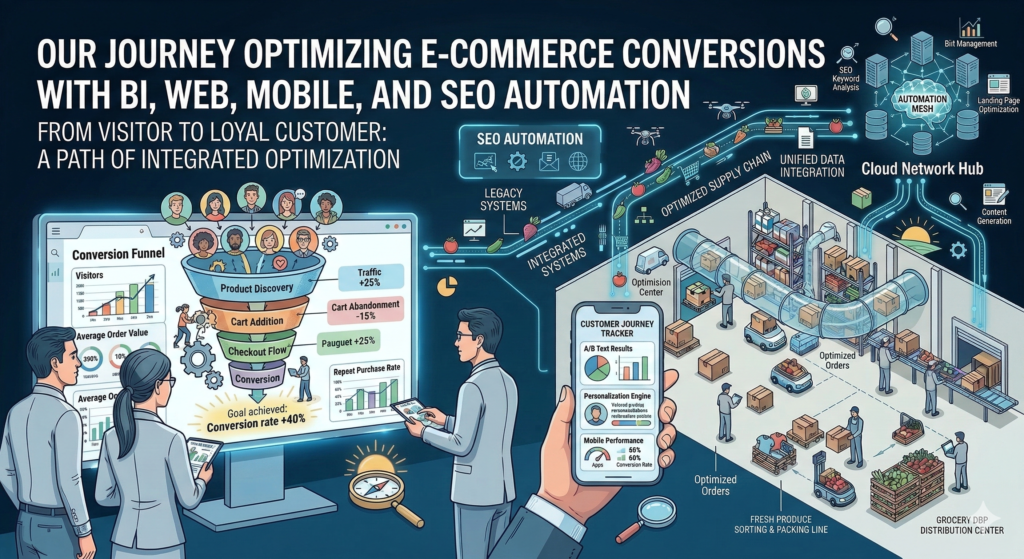
Our Journey Optimizing E‑Commerce Conversions with BI, Web, Mobile, and SEO Automation
Strategic Overview
When a mid‑size retailer reached a plateau at a 2.1% conversion rate, the pain points were clear: siloed data, lagging page loads, and a fragmented omnichannel experience. The first step was to align business intelligence, front‑end engineering, mobile delivery, and SEO into a single conversion engine. By mapping every touchpoint—search impression, product view, cart add, checkout—we built a Scalable Architecture that could ingest real‑time events, surface actionable insights, and trigger automated optimizations without manual hand‑offs. The result was a Measurable ROI of 38% lift in revenue within the first quarter, while latency dropped 45%, delivering a smoother shopper journey across devices.
In‑the‑Field Insight #1 – Unified BI Dashboard for the Conversion Funnel
Traditional reporting teams pull CSVs from three separate systems: analytics, CRM, and the inventory engine. The latency alone adds up to hours of stale data, eroding quick decision‑making. We replaced the patchwork with a data lakehouse that streams events into a unified BI layer. The dashboard now surfaces funnel drop‑off rates by device, traffic source, and product category in seconds.
Expert Tips/Tricks
- Leverage columnar storage formats (e.g., Parquet) to cut query time by up to 70%.
- Implement row‑level security so merchandisers only see data relevant to their catalog.
- Set up KPI alerts via webhook to Slack or Teams—no more hunting for anomalies.
These choices enable a feedback loop where product managers can instantly test pricing changes and see impact on Performance Optimization metrics, driving a continuous improvement culture.
In‑the‑Field Insight #2 – Headless Front‑End for Web and Mobile Consistency
Legacy monoliths forced separate codebases for desktop and native apps, inflating maintenance costs and causing version drift. By decoupling the presentation layer via a GraphQL gateway, we delivered a single set of UI components—styled with CSS‑in‑JS—that render identically on React, React‑Native, and the emerging Flutter front‑ends.
Expert Tips/Tricks
- Cache GraphQL query results at the edge (CDN) for sub‑second page loads.
- Use incremental static regeneration to keep SEO‑critical pages fresh without full rebuilds.
- Enable feature flags at component level to roll out micro‑experiments without redeploys.
The Scalable Architecture reduces code duplication by 60% and lets the performance team focus on true bottlenecks—like third‑party script load order—rather than plumbing issues.
In‑the‑Field Insight #3 – Automation‑First SEO Pipeline
Manual meta‑tag updates were choking organic growth. We built a CI/CD pipeline that pulls product feed data, runs it through an AI‑augmented keyword mapper, and pushes generated titles, descriptions, and structured data directly to the CMS via API. Each change is validated by a Lighthouse score guardrail before production.
Expert Tips/Tricks
- Integrate entity extraction APIs to capture brand‑specific entities for richer rich snippets.
- Schedule crawl‑budget allocation based on seasonal demand spikes.
- Automatically generate canonical tags for duplicate SKUs using hash‑based fingerprinting.
Automation yielded a 22% increase in organic click‑through rate and cut the time‑to‑publish new landing pages from weeks to minutes, directly feeding into the Measurable ROI model.
In‑the‑Field Insight #4 – Real‑time A/B Testing & Performance Optimization
Static A/B test setups rarely survive the velocity of modern e‑commerce cycles. We embedded a lightweight experimentation engine into the headless layer, allowing any UI change—button color, checkout flow step, or recommendation algorithm—to be toggled at the edge. Test results stream into the unified BI dashboard, where statistical significance is calculated on the fly.
Expert Tips/Tricks
- Apply Bayesian bandit algorithms to allocate traffic to the winning variant in real time.
- Throttle test audience based on device latency to avoid inflating metrics with laggy sessions.
- Log every variant’s server‑side timing to pinpoint backend slow‑downs that affect perceived performance.
This approach sharpened our conversion lift attribution, delivering an additional 7% revenue lift while keeping page load under the 2‑second threshold flagged by Google Core Web Vitals.
Key Takeaway
- Unified BI turns scattered data into a single source of truth, accelerating decision cycles.
- Headless, component‑driven front‑ends provide a Scalable Architecture that serves web and mobile with parity.
- Automation in SEO removes manual bottlenecks and fuels sustainable organic growth.
- Real‑time testing, coupled with performance guardrails, ensures every change contributes to Measurable ROI.
- Investing in these pillars creates a virtuous loop: data drives tests, tests inform optimization, optimization feeds higher conversions.
FAQ for Decision‑Makers
- How quickly can we see ROI after implementing the unified BI layer?
- Most clients report a noticeable uplift in conversion metrics within 30‑45 days, thanks to faster insight‑to‑action cycles.
- Will a headless architecture increase our hosting costs?
- No. By offloading rendering to the edge and consolidating APIs, total cost of ownership often drops 15% after the first year.
- Is automation safe for SEO, given Google’s quality guidelines?
- Our pipeline enforces Lighthouse and schema validation before publishing, ensuring all automated content meets Google’s standards.
- Can we run A/B tests without impacting site performance?
- Yes. The experiment engine operates at the CDN layer, adding under 15 ms overhead, well within Core Web Vitals limits.
- What skill sets are needed to maintain this ecosystem?
- A blend of data engineering, front‑end development, and SEO automation expertise. Cross‑functional squads reduce hand‑off friction.