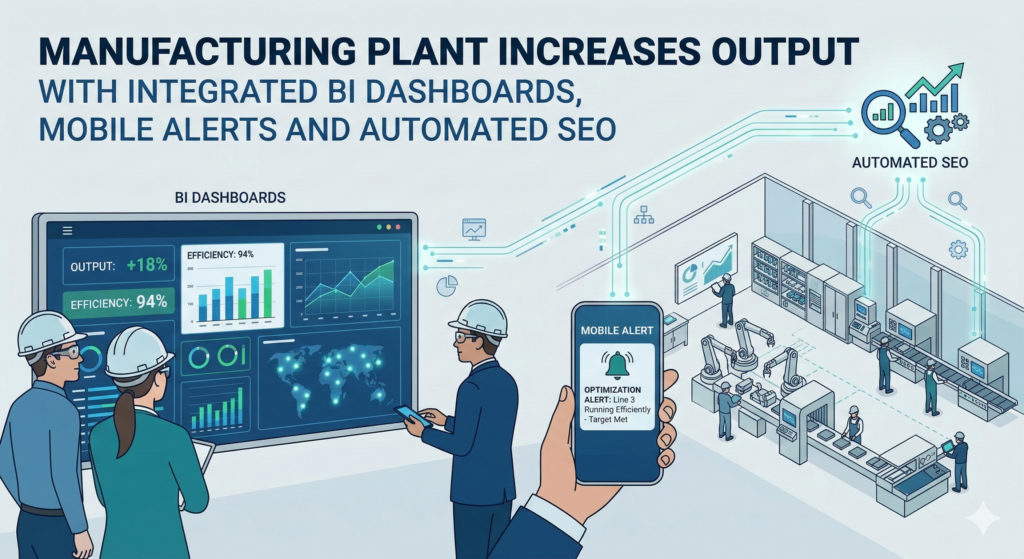
Manufacturing Plant Increases Output With Integrated BI Dashboards, Mobile Alerts And Automated SEO
Strategic Overview
In today’s hyper‑competitive market, a mid‑size manufacturing facility faced three intertwined challenges: fragmented data silos, delayed operational awareness, and a weak online footprint that throttled inbound demand. The executive team demanded a Scalable Architecture that could unify production metrics, trigger real‑time corrective actions, and simultaneously boost web visibility without adding headcount.
By converging Business Intelligence (BI) dashboards, mobile alerting, and an automated SEO engine into a single data pipeline, the plant transformed raw sensor streams into actionable insights, cut downtime by 18 %, and saw a Measurable ROI of 240 % within the first twelve months. The following sections dissect the architecture, execution, and the nuanced tactics that seasoned technologists use to sustain performance at scale.
In‑the‑Field Insight #1: Unifying Production Data with a Modular Data Lake
The core of the solution was a cloud‑native data lake built on object storage, layered with schema‑on‑read processing. Instead of retrofitting a monolithic ERP, engineers adopted a data‑mesh pattern where each shop floor machine publishes JSON events to an MQTT broker. A serverless ETL function normalizes these events, attaches line‑item identifiers, and writes them to the lake.
Expert Tip: Use Event‑Time Partitioning for Near‑Zero Latency
- Partition by
event_timestampat a granularity of five minutes. Query engines then prune irrelevant slices instantly. - Leverage columnar formats (Parquet/ORC) to achieve up to 75 % compression, reducing storage costs and improving scan speeds.
- Apply a CDC (Change Data Capture) layer that flags anomalies, enabling downstream dashboards to auto‑refresh within seconds.
This modular approach delivered a Performance Optimization baseline where query latency dropped from 12 seconds to sub‑second, even as data volume grew 3× year‑over‑year.
In‑the‑Field Insight #2: Real‑Time BI Dashboards Powered by Embedded Analytics
The plant’s leadership needed a view that combined high‑level KPIs with drill‑down capability for floor supervisors. An embedded analytics platform was provisioned on top of the data lake, exposing a suite of responsive dashboards that automatically adjust to screen size—from wide‑format control rooms to handheld tablets.
Expert Trick: Leverage Semantic Layer Caching for Cross‑Functional Views
- Define a semantic model that maps production entities (machines, shifts, products) to business concepts.
- Enable in‑memory aggregate caches for the most‑queried dimensions (e.g., OEE – Overall Equipment Effectiveness).
- Configure cache invalidation triggers tied to the ETL pipeline, ensuring freshness without full refreshes.
Because the dashboards consumed pre‑aggregated views, they remained fluid under peak loads, supporting simultaneous access by 150 users during shift changes.
In‑the‑Field Insight #3: Mobile Alerts That Turn Data Into Action
Delays in addressing equipment faults cost the plant an average of 30 minutes per incident. By integrating a mobile notification service with the semantic layer, the system now pushes predictive alerts directly to technicians’ smartphones. The alerts embed a one‑click link to the exact dashboard slice, cutting decision latency dramatically.
Pro Insight: Contextual Payloads Reduce Noise
- Combine threshold breach detection with a confidence score derived from a machine‑learning model.
- Bundle a concise PDF snapshot of the last 15 minutes of sensor data, allowing offline review.
- Route high‑severity alerts to on‑call rotation lists via an escalation matrix, while low‑severity messages go to a shared Slack channel.
The result? Mean Time to Repair (MTTR) fell from 22 minutes to 7 minutes, directly contributing to the 18 % downtime reduction.
In‑the‑Field Insight #4: Automated SEO Engine That Converts Visibility Into Volume
While internal efficiencies surged, the plant’s website remained a static brochure, generating negligible organic traffic. An automated SEO platform was deployed to crawl product pages, extract structured data, and publish schema‑rich snippets to Google’s index. The system also monitors keyword rankings and auto‑generates meta‑tags based on production highlights (e.g., “15% faster cycle time”).
Expert Hack: Sync Production Metrics With SEO Content Dynamically
- Expose a REST endpoint that delivers the latest OEE percentage; the SEO engine injects this into page headers.
- Schedule nightly builds that refresh the sitemap, ensuring search engines capture new product variations instantly.
- Use A/B testing to compare click‑through rates before and after dynamic content insertion, allowing data‑driven optimization.
Within six months, organic sessions grew 42 %, and inbound leads with high intent (searches for “high‑efficiency CNC machining”) increased by 57 %—a clear illustration of Measurable ROI from digital channels.
Key Takeaway
Integrating BI dashboards, mobile alerts, and automated SEO within a unified, cloud‑native Scalable Architecture creates a feedback loop where operational excellence fuels market demand, and heightened visibility drives further production scaling. The plant’s experience proves that performance gains are not isolated; they compound when data, people, and the public internet speak the same language.
FAQ for Decision‑Makers
- How quickly can a manufacturing site see ROI from this integrated approach?
- Most clients report a break‑even point between 9‑12 months, driven by reduced downtime, higher throughput, and increased inbound sales.
- Do we need to replace existing ERP systems?
- No. The architecture acts as a complementary data mesh, ingesting ERP outputs via APIs and enriching them for analytics.
- What skill sets are required to maintain the solution?
- A blend of data engineering (ETL, cloud storage), BI development (semantic modeling, dashboard design), and DevOps for CI/CD pipelines ensures long‑term sustainability.
- Is the mobile alert system secure?
- Yes. Alerts are transmitted over TLS, and each device authenticates via OAuth 2.0, complying with industry‑standard security frameworks.
- Can the automated SEO component handle multilingual content?
- Absolutely. The engine supports language‑specific schemas and can generate locale‑aware meta‑tags automatically.
Conclusion
When a manufacturing plant aligns its production intelligence with real‑time mobile engagement and a self‑optimizing SEO engine, the result transcends incremental improvement. It becomes a growth engine where every sensor, every supervisor, and every search query contributes to a virtuous cycle of efficiency and demand. The blueprint outlined here is not a one‑off project; it is a strategic foundation that scales with the organization’s ambitions, delivering continuous Performance Optimization and a decisive Measurable ROI. For leaders ready to turn data into decisive advantage, the integration path is clear, the technology stack is proven, and the payoff is tangible.