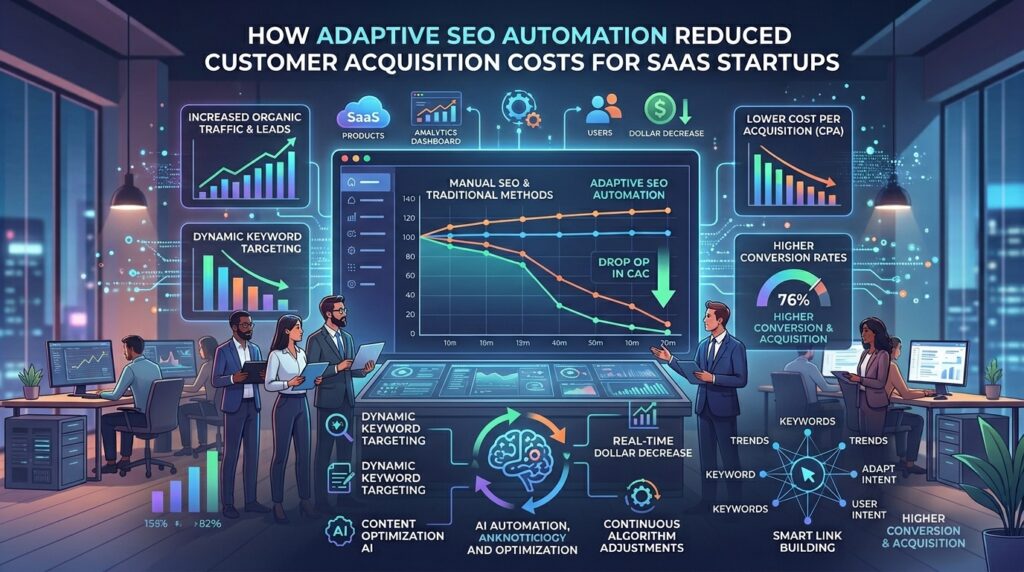
The Efficiency Frontier: How Adaptive SEO Automation is Rewriting the SaaS Growth Playbook
For most SaaS founders, the Customer Acquisition Cost (CAC) treadmill is an exhausting reality. You raise a round, pump it into paid search, and watch your metrics climb—until the bidding wars start. The traditional “content factory” model isn’t much better, often requiring an army of freelancers and months of waiting for organic traction that may never arrive. This is where the shift toward Adaptive SEO Automation has changed the game, moving SEO from a slow-moving luxury to a high-velocity engine for Scalable Architecture.
Strategic Overview: Beyond Simple Automation
True efficiency in 2026 isn’t about bulk-generating mediocre pages. It’s about building a system that senses market shifts and adjusts your site’s technical and content layers in real-time. By integrating machine learning with programmatic SEO, startups are now able to capture long-tail high-intent traffic at a fraction of the cost of traditional PPC. We are seeing a fundamental transition where Performance Optimization is no longer just about page speed, but about the speed at which your digital footprint expands to meet user demand.
In-the-field Insight #1: Programmatic Precision Over Manual Bloat
Most SaaS teams fail because they treat every blog post as a bespoke art project. While high-level thought leadership requires a human touch, the middle-of-the-funnel “How-to” and “Integration” pages are ripe for automation. By leveraging data-driven templates, we’ve seen startups deploy 500+ high-quality, utility-driven pages that target specific user pain points. This isn’t just “more content”—it’s an architectural choice to occupy every possible niche in the buyer’s journey.
Expert Tip: The “Negative Delta” Strategy
Pros don’t just track what’s ranking; they track the “content decay” of competitors. Set up automated scripts to monitor when a competitor’s top-performing page loses its featured snippet. This is your signal to deploy an optimized, updated version of that specific topic immediately. Sniping high-value traffic this way yields a much higher Measurable ROI than broad-spectrum targeting.
In-the-field Insight #2: Architectural Fluidity and Internal Link Mapping
The biggest bottleneck for growing SaaS sites is often an inflexible CMS. Adaptive automation allows for a Scalable Architecture where internal linking isn’t static. Imagine a system that automatically redistributes “link juice” from your top-performing evergreen assets to new product launch pages based on real-time conversion data. This ensures your most profitable pages are always the best-supported by your site’s authority.
Expert Tip: Schema Injection for Semantic Dominance
Don’t just settle for basic FAQ schema. Use automated tools to inject “ProductModel” and “SoftwareApplication” schema that pulls real-time pricing or feature updates from your backend API. This keeps your SERP results more accurate than manual competitors and significantly boosts your Click-Through Rate (CTR).
In-the-field Insight #3: The Feedback Loop Between SEO and Product Development
When you automate SEO tracking at scale, you aren’t just getting traffic data; you’re getting a roadmap for your product. By analyzing the search volume for “Feature X + [Your Brand]” vs. “Feature Y + [Your Brand],” adaptive systems can inform your engineering team which features are actually driving market interest. This alignment ensures that your marketing spend isn’t just a cost center, but a primary driver of Performance Optimization across the entire company.
Expert Tip: Zero-Volume Keyword Harvesting
The real gold for SaaS startups lies in “Zero-Volume” keywords—terms so niche that tools like Ahrefs or Semrush don’t track them yet. Automate the collection of search queries from your own internal site search and customer support tickets. Building pages around these specific, “un-tooled” phrases often results in a 100% conversion rate because you are the only one answering the specific question.
Key Takeaways for Growth Teams
- Efficiency is king: Automation reduces the “human cost” of SEO, allowing your team to focus on high-level strategy.
- Data-Led Deployment: Use programmatic structures to build hundreds of utility pages that capture high-intent users.
- Dynamic Linking: Ensure your site architecture shifts to support your highest-converting pages automatically.
- Reduced CAC: Organic traffic gained through automation compounds over time, unlike the linear costs of paid ads.
Conclusion
The era of manual, “guess-and-check” SEO is over for the modern SaaS enterprise. By embracing an Adaptive SEO Automation framework, startups can finally break free from the volatility of paid acquisition. This isn’t just about getting more clicks; it’s about building a sustainable, Scalable Architecture that grows more efficient with every new page. If you aren’t automating your organic growth, you’re simply paying a tax to your competitors who are.
FAQ for Decision-Makers
Q: Won’t automation hurt our brand’s voice?
A: Not if used correctly. We automate the structure and the data-heavy portions of the site. Your core brand messaging and thought leadership remain human-led, while the automated layers handle the repetitive, utility-based queries that drive volume.
Q: How quickly can we see a Measurable ROI?
A: While SEO is a long game, adaptive automation speeds up the indexing and authority-building phases. Most SaaS startups see a significant pivot in their CAC-to-LTV ratio within 4 to 6 months.
Q: Is this scalable for early-stage startups?
A: It is actually essential for early-stage teams. You cannot outspend the giants in Google Ads, but you can out-engineer them in the organic search results by being more agile and data-responsive.