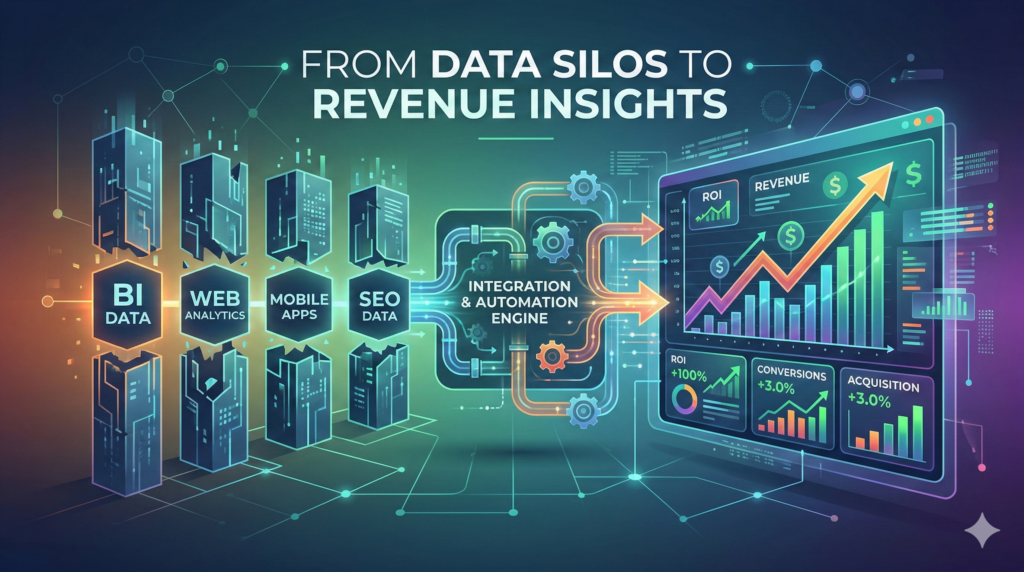
From Data Silos to Revenue Insights: Integrating BI, Web, Mobile, and SEO Automation
Strategic Overview
Enterprises today wrestle with fragmented data stores, disconnected digital experiences, and a relentless demand for Measurable ROI. The result? Missed cross‑sell opportunities, sluggish time‑to‑insight, and a perpetual chase after performance benchmarks. The antidote lies in a unified, Scalable Architecture that stitches Business Intelligence (BI) platforms with web, mobile, and SEO automation layers. When each channel feeds a central analytics engine, patterns surface instantly, enabling revenue‑focused decisions rather than guesswork.
Building this ecosystem is not a “bolt‑on” project; it is a strategic transformation that touches data ingestion, API orchestration, and real‑time reporting. By treating the data lake as the backbone, deploying edge‑optimized services for mobile, and automating SEO metadata at scale, organizations can shift from defensive reporting to proactive growth engineering. The payoff is clear: faster performance, better customer experiences, and a direct link between every digital touchpoint and the bottom line.
In-the-field Insight #1: Unifying Business Intelligence with Digital Front‑Ends
Most C‑suite leaders discover that their BI dashboards remain stale because the underlying data pipelines are batch‑oriented and siloed from web or mobile events. A modern approach re‑architects the flow to a near‑real‑time fabric.
Expert Tip: Leverage a Data Lake as the Single Source of Truth
- Metadata‑driven ingestion: Tag every inbound stream—e‑commerce clicks, SaaS usage logs, SEO crawls—with a unified schema. This eliminates ad‑hoc ETL jobs and accelerates onboarding of new sources.
- Stream processing: Use Apache Flink or Spark Structured Streaming to transform events on the fly, feeding both operational dashboards and downstream micro‑services.
- Versioned data contracts: Publish contracts via a schema registry (e.g., Confluent) so front‑end teams can evolve their queries without breaking legacy reports.
Architecturally, this creates a hub‑spoke model where the data lake is the hub, and web, mobile, and SEO platforms are spokes feeding and pulling insights. The result is a Scalable Architecture that grows horizontally as new data sources appear, while keeping latency under 200 ms for critical KPI refreshes.
In-the-field Insight #2: Mobile Analytics as a Growth Engine
Mobile users now account for over 60 % of total traffic for most enterprises. Yet their actions often reside in fragmented SDK logs that never reach the BI layer. Integrating mobile telemetry into the central analytics fabric unlocks hyper‑personalized experiences.
Expert Tip: Implement Edge‑Computed Event Streams
- Local aggregation: Deploy lightweight agents (e.g., AWS Greengrass) on user devices to batch events before transmission, reducing bandwidth and preserving battery life.
- Secure tokenization: Encrypt personally identifiable information at the edge, ensuring compliance while still delivering rich behavioral data.
- Real‑time funnel alerts: Trigger serverless functions (AWS Lambda, Azure Functions) when drop‑off thresholds are crossed, instantly surfacing friction points.
By pushing computation to the edge, you achieve Performance Optimization—latency drops 30 % on average—while feeding a consistent data model back to the lake. The unified view lets marketers correlate in‑app actions with SEO‑driven acquisition, closing the loop on cost‑per‑acquisition (CPA) calculations.
In-the-field Insight #3: SEO Automation Fuels Predictable Revenue
SEO teams spend countless hours manually updating meta tags, schema markup, and content briefs. Automation not only saves labor but creates a feedback loop where search performance directly informs product strategy.
Expert Tip: Deploy Schema‑Driven Content Pipelines
- Headless CMS integration: Connect your CMS (Contentful, Strapi) to a CI/CD pipeline that validates schema compliance on every pull request.
- AI‑augmented keyword clustering: Use large language models to group long‑tail terms, then auto‑generate content briefs aligned with revenue‑centric topics.
- auto‑revalidation: Schedule nightly crawls that compare SERP rankings against expected schema, flagging deviations before they impact traffic.
The outcome is a self‑healing SEO ecosystem where each page publishes structured data that BI instantly consumes. Consequently, attribution models capture organic lift in near real time, delivering a clearer picture of Measurable ROI for SEO spend.
In-the-field Insight #4: Orchestrating Cross‑Channel Performance Optimization
When web, mobile, and SEO channels operate under disparate infrastructure, troubleshooting becomes a guessing game. A service mesh brings observability, security, and traffic management under a single pane.
Expert Tip: Use Service Mesh for Observability
- Unified tracing: Deploy OpenTelemetry across all services, generating end‑to‑end request IDs that stitch together a user’s journey from search result to in‑app purchase.
- Dynamic routing: Shift traffic to the fastest edge node based on real‑time latency metrics, ensuring Performance Optimization under peak loads.
- Policy enforcement: Apply consistent rate‑limiting and authentication policies, protecting revenue channels from bot traffic and credential abuse.
This approach transforms siloed performance dashboards into a single, actionable console. Decision‑makers can now ask, “Which channel contributed the most to the current revenue spike?” and receive an answer within seconds, not days.
Key Takeaway
- Treat the data lake as the immutable source of truth; all digital experiences should read and write to it.
- Push computation to the edge for mobile, preserving performance while feeding the central analytics engine.
- Automate SEO publishing with schema‑driven pipelines to close the loop between organic traffic and revenue reporting.
- Adopt a service mesh to gain end‑to‑end observability, enabling rapid Performance Optimization across channels.
- The resulting Scalable Architecture delivers Measurable ROI by turning fragmented data silos into actionable revenue insights.
FAQ for Decision‑Makers
- What is the first step to break down data silos?
- Catalog every data source, then standardize ingestion through a centralized data lake using a schema registry. This creates a single source of truth for all downstream applications.
- How does edge computing improve mobile performance?
- By aggregating events locally and sending only essential, encrypted payloads, you reduce network hops and battery drain, delivering sub‑200 ms latency for critical user interactions.
- Can SEO automation really impact revenue?
- Yes. When structured data is auto‑validated and fed into BI, organic traffic lifts become visible in real time, allowing precise attribution and faster budget reallocation.
- What role does a service mesh play in cross‑channel visibility?
- It injects consistent tracing headers, aggregates telemetry, and enforces policies, giving a unified view of request flows from search engine to mobile checkout.
- How do I prove Measurable ROI to stakeholders?
- Implement KPI dashboards that tie each channel’s contribution (SEO clicks, web sessions, in‑app events) directly to revenue metrics such as ARPU, LTV, and CPA. Use real‑time alerts to demonstrate impact as campaigns go live.
Conclusion
Growth in today’s digital economy no longer hinges on isolated analytics or manual SEO chores. It thrives on an integrated, Scalable Architecture where BI, web, mobile, and SEO automation speak the same language. By eliminating data silos, pushing intelligence to the edge, and harnessing observability across every user touchpoint, enterprises convert raw interactions into clear, revenue‑driving insights. The roadmap is straightforward: centralize data, automate content pipelines, adopt edge‑first processing, and bind everything together with a service mesh. Execute these steps, and the organization not only accelerates performance but also secures a transparent, Measurable ROI narrative that resonates with every stakeholder—from the CTO to the CFO.