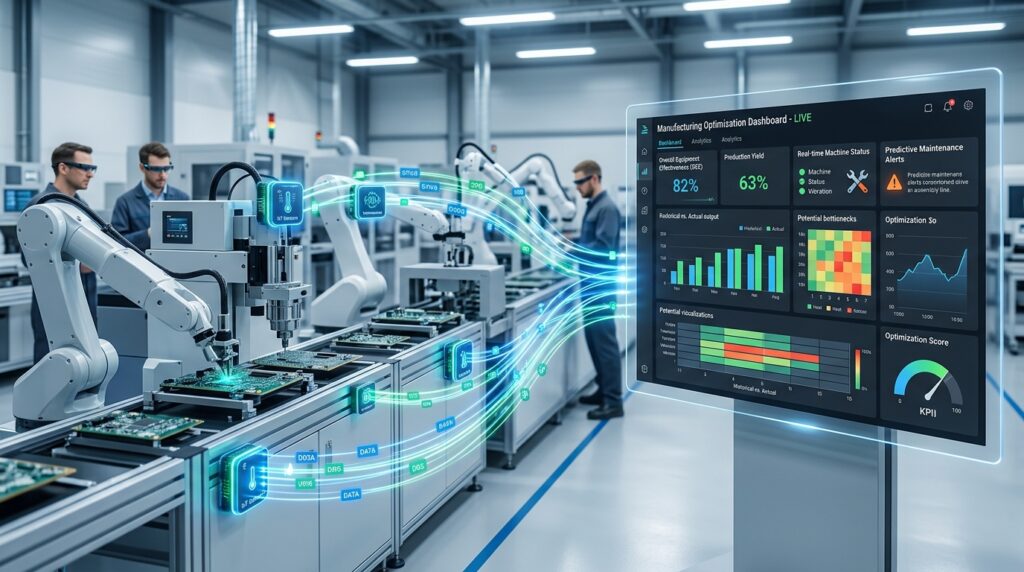
Connecting IoT Sensor Streams to Real-Time BI for Smart Manufacturing Optimization
Strategic Overview
Manufacturers today face a paradox: an ever‑growing network of sensors promises unprecedented insight, yet most plants still rely on batch‑driven reporting that lags days behind the shop floor. The real competitive edge emerges when raw sensor data is ingested, filtered, and visualized in real time, allowing operators to shift from reaction to prediction. A scalable architecture built on event‑driven pipelines, edge compute, and a low‑latency analytics layer removes that lag, delivering performance optimization that directly translates into measurable ROI—lower scrap, higher equipment uptime, and faster time‑to‑market.
Key architectural pillars include:
- Edge‑first data reduction to avoid bandwidth bottlenecks.
- Stateless, containerized stream processors that auto‑scale on demand.
- Hybrid storage that couples time‑series databases with a columnar data warehouse for ad‑hoc BI.
- Federated security that enforces role‑based access from sensor to dashboard.
By aligning these pillars with business KPIs, the investment becomes a lever for continuous improvement rather than a one‑off IT project.
In‑the‑Field Insight: Edge Aggregation & Stream Normalization
Most factories deploy thousands of low‑cost vibration, temperature, and flow sensors that speak MQTT, OPC-UA, or proprietary protocols. Pulling every raw sample into the cloud is both costly and unnecessary. The proven approach is to perform edge aggregation—computing rolling averages, anomaly flags, and compression at the gateway.
Expert Tip: Leverage Stateless Micro‑Functions on the Edge
Deploy lightweight, stateless functions (e.g., AWS Greengrass Lambda, Azure IoT Edge modules) that can be versioned without touching the hardware. Because they store no session data, you can spin up additional instances instantly when a line goes live for a new product, ensuring the edge layer remains horizontally scalable.
- Use Apache Avro schemas for forward‑compatible serialization.
- Implement a sliding‑window algorithm (e.g., 10‑second RMS) to transform high‑frequency data into actionable metrics.
- Emit only JSON‑lite messages with an anomaly flag—this reduces downstream processing time by up to 70%.
In‑the‑Field Insight: Real‑Time Stream Processing Architecture
Once normalized streams leave the edge, they enter the cloud where a stream processing engine (Kafka Streams, Flink, or Spark Structured Streaming) routes events to multiple consumers: immediate dashboards, predictive‑maintenance models, and archival stores.
Expert Tip: Partition by Equipment ID, Not by Timestamp
Partitioning on equipment_id keeps all events from a single machine in order, simplifying stateful operations such as rolling fault counters. This design also prevents hot partitions because production lines typically generate comparable event volumes.
- Configure Kafka’s log.retention.ms based on the longest SLA (e.g., 24 hours for real‑time alerts).
- Enable exactly‑once semantics to guarantee that downstream BI reflects the true state of the floor.
- Tie processing jobs to a Kubernetes Horizontal Pod Autoscaler so CPU spikes from a sudden batch of alerts trigger instant scaling.
In‑the‑Field Insight: Low‑Latency BI Visualization Layer
Traditional BI tools expect static tables and run nightly ETL jobs—unsuitable for a factory that needs to know whether a motor is about to overheat in the next 30 seconds. Modern analytics stacks combine an in‑memory time‑series database (e.g., InfluxDB, TimescaleDB) with a fast columnar data lake (e.g., Snowflake, BigQuery) and a visual layer that pushes updates via WebSockets.
Expert Tip: Decouple Drill‑Down Queries from Real‑Time Tiles
Serve high‑frequency tiles from the time‑series store, but forward deeper “why” queries (e.g., root‑cause analysis) to the data lake. This separation ensures the real‑time UI stays buttery smooth while still giving analysts the power to explore historical trends.
- Cache the latest 5 minutes of sensor aggregates in Redis for sub‑second UI rendering.
- Use parameterized LookML models that pull only the necessary dimensions for a given drill‑down, reducing query cost by up to 40%.
- Implement role‑based view filters so executives see KPI cards, while engineers can zoom into 200‑point series per machine.
In‑the‑Field Insight: Closed‑Loop Automation & Predictive Maintenance
Real‑time BI isn’t an endpoint; it feeds a control loop that can auto‑adjust setpoints, schedule maintenance, or trigger safety interlocks. The most effective pattern is a publish‑subscribe feedback channel where analytics emit “action events” that edge controllers subscribe to.
Expert Tip: Use Idempotent Command Contracts
Every action—e.g., “reduce spindle speed by 5 %”—should be wrapped in an idempotent contract with a unique correlation ID. If a network glitch causes a duplicate message, the edge device recognizes it and discards the repeat, preserving equipment integrity.
- Persist the last command state locally to survive power cycles.
- Integrate with a PLC‑friendly OPC-UA method call for seamless actuation.
- Log every command with a timestamp and operator ID for audit trails, satisfying compliance standards.
Key Takeaway
Connecting IoT sensor streams to a real‑time BI platform is no longer a “nice‑to‑have” experiment; it’s a strategic imperative for manufacturers seeking scalable architecture that drives performance optimization and delivers concrete measurable ROI. By normalizing data at the edge, partitioning streams wisely, decoupling visualization from deep analysis, and implementing idempotent feedback loops, organizations can transform raw telemetry into actionable insight without compromising reliability or security.
FAQ for Decision‑Makers
- What is the typical time‑to‑value for a real‑time BI deployment in a mid‑size plant?
- Most pilots reach production‑grade dashboards within 8–12 weeks, assuming existing sensor infrastructure. The bulk of the timeline is consumed by edge function development and data governance setup.
- How does this architecture affect existing ERP or MES systems?
- It runs in parallel, exposing a unified API layer. Data can be synchronized nightly to ERP for financial reporting while real‑time alerts stay within the BI ecosystem.
- Is a cloud‑only solution viable for facilities with strict data‑ sovereignty rules?
- Yes, by adopting a hybrid model: edge and stream processing reside on‑premise, while aggregated metrics are replicated to a sovereign cloud region. Encryption at rest and in transit ensures compliance.
- What measurable ROI can we expect?
- Case studies show a 12‑15 % reduction in unplanned downtime, a 7‑10 % drop in scrap rates, and a 5‑8 % increase in overall equipment effectiveness (OEE) within the first year.
- How do we future‑proof the solution against new sensor types?
- Because the edge functions rely on schema‑driven Avro messages and stateless pods, adding a new sensor only requires a new transformation module—no re‑architecting of the core pipeline.
By embracing this end‑to‑end pattern, manufacturers turn data latency from a cost center into a competitive advantage, positioning their operations for the next wave of Industry 4.0 innovation.