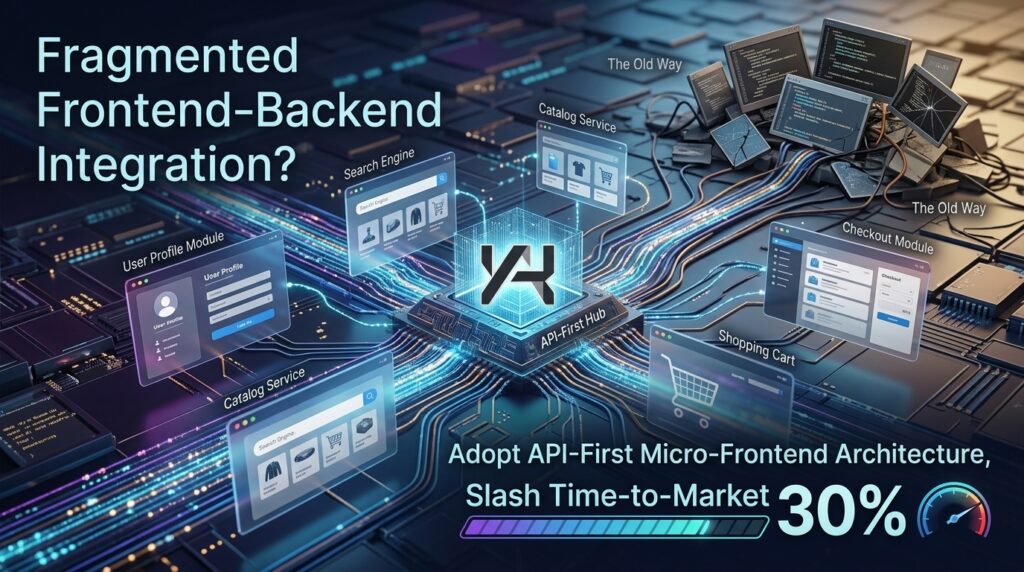
Fragmented Frontend-Backend Integration? Hacronics’ API-First Micro-Frontend Architecture Slashes Time-to-Market by 30%
Fragmented frontend-backend integration creates deployment bottlenecks, slowing feature releases and increasing failure risks in monolithic setups. Hacronics pioneers an API-First Micro-Frontend Architecture that decouples teams for independent deployments, enabling Scalable Architecture and Performance Optimization with proven Measurable ROI.
Strategic Overview: Why API-First Micro-Frontends Transform Development
Monolithic frontends force single pipelines for all changes, inflating build times and delaying market response. Hacronics’ approach integrates micro-frontends with robust APIs, allowing parallel team work, tech-agnostic stacks, and precise scaling—directly addressing coordination bottlenecks for faster innovation and reduced tech debt.
4 Technical Insights for Implementation
- Independent Deployments Eliminate Bottlenecks: Teams deploy modules without full rebuilds, cutting feature rollout by up to 40% as seen in enterprise adoptions—Hacronics optimizes this for Scaling Global Traffic Spikes with Serverless Micro-Frontends.
- Tech Stack Flexibility Drives Agility: Mix React, Vue, or Angular per module without global constraints, easing modernization and hiring—ideal for gradual legacy migrations.
- Precise Resource Scaling on Kubernetes: Scale only high-traffic modules, saving infrastructure costs and boosting efficiency in process-driven apps. Learn more at web.dev Micro-Frontends Guide.
- Smaller Codebases Enhance Maintainability: Decoupled components reduce errors, speed navigation, and support role-based reusability—Hacronics delivers this via API gateways for seamless integration. See Microsoft docs at Micro-frontends Architecture.
Key Takeaway: Measurable ROI Awaits
Hacronics’ API-First Micro-Frontend Architecture delivers 30% faster time-to-market through Performance Optimization and autonomous scaling, turning fragmented systems into agile, revenue-driving engines.
FAQ
Large teams facing merge conflicts, slow releases, or legacy migrations—Hacronics assesses via code audits for quick wins.
APIs act as stable contracts, decoupling frontend evolution from backend changes for independent scaling and zero-downtime updates.
Teams see 30% time-to-market cuts in 3-6 months, with sustained gains in velocity and reduced ops costs.
Yes—Hacronics enables gradual adoption, integrating legacy as modules via containerized iframes or Web Components.