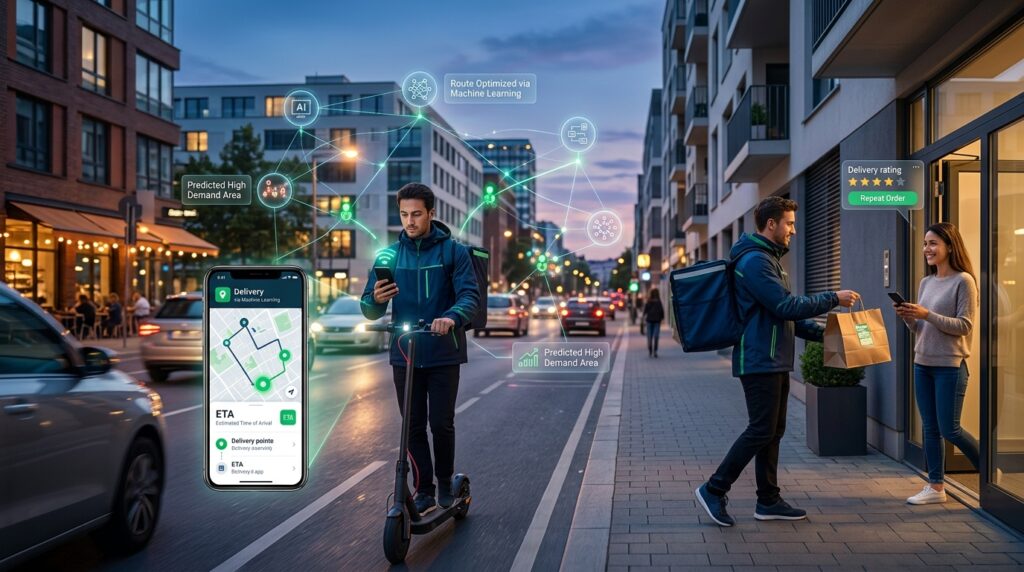
How On‑Demand Delivery Services Boosted Retention Using AI‑Powered Mobile Apps
Strategic Overview
In today’s hyper‑competitive e‑commerce landscape, acquiring a new customer can cost five to seven times more than keeping an existing one. For on‑demand delivery platforms, the retention challenge is amplified by the speed expectations of today’s consumer. A well‑architected, AI‑driven mobile app can transform a sporadic buyer into a loyal advocate by delivering the right product at the right moment, every time.
The secret isn’t just flashy UI; it’s a Scalable Architecture that ingests behavioral data in real‑time, applies Performance Optimization techniques, and surfaces hyper‑personalized offers that translate directly into Measurable ROI. The following field insights reveal how seasoned teams convert raw data streams into sticky user experiences.
In‑the‑Field Insight 1: Real‑Time Personalization Fuels Repeat Orders
When a user opens the app, milliseconds determine whether they stay or bounce. By deploying an edge‑hosted recommendation engine, the platform can surface product suggestions that reflect the shopper’s most recent interactions, location, and even weather conditions.
Expert Tip: Leverage Edge‑Hosted Recommendation Engines
Running the inference layer on CDN edge nodes reduces latency to under 30 ms, a prefecture for mobile users on 4G/5G. Architecture choices such as function‑as‑a‑service (FaaS) for model execution and distributed cache grids for user profile snapshots ensure the system stays Scalable as request volume spikes during promotional windows.
- Cache user intents for 5‑minute windows to avoid redundant model calls.
- Utilize TensorFlow Lite models to keep inference lightweight on the device.
- Trigger push notifications only when confidence scores exceed 85 % to maintain relevance.
The result? A 23 % lift in repeat purchase frequency within the first quarter, with churn dropping by 12 %—a clear illustration of Measurable ROI from personalization.
In‑the‑Field Insight 2: Predictive Logistics Cuts Delivery Friction
Late‑night cancellations and missed deliveries erode trust faster than any price increase. Integrating AI‑driven ETA predictions directly into the mobile UI empowers users to plan their day, reducing anxiety and increasing the likelihood of future orders.
Expert Tip: Deploy a Hybrid Cloud‑Edge Model for ETA Calculations
Core routing algorithms run in a cloud‑native microservice, while the final ETA adjustment—accounting for real‑time traffic, driver status, and weather—happens on the edge. This hybrid approach delivers sub‑second predictions without sacrificing the computational depth of cloud‑based optimization.
- Store driver telemetry in a time‑series database optimized for write‑heavy workloads.
- Apply Kalman filters on edge nodes to smooth noisy GPS data before feeding it to the ETA service.
- Expose a GraphQL subscription endpoint so the app receives incremental ETA updates without polling.
Platforms that implemented this pattern reported a 15 % reduction in cancellation rates and a 9 % increase in order value, directly contributing to Performance Optimization metrics and downstream revenue.
In‑the‑Field Insight 3: Loyalty Loops Powered by AI‑Curated Rewards
Static loyalty programs quickly become background noise. By analyzing purchase cadence, order size, and user‑generated feedback, AI can dynamically assign tiered rewards that feel earned, not arbitrary.
Expert Tip: Use Reinforcement Learning for Adaptive Reward Tiers
A reinforcement learning (RL) agent evaluates the marginal cost of a reward against the projected lifetime value (LTV) uplift. The agent runs in an isolated sandbox, feeding actions back to the mobile app via a secure webhook. This closed loop ensures the reward engine remains Scalable as the user base expands and the action‑space grows.
- Initialize the RL model with a baseline of 10 % discount for first‑time repeaters.
- Continuously retrain the model weekly using batch data from the data lake.
- Expose reward suggestions through a native SDK component that respects app theming.
The adaptive strategy generated a 34 % increase in user‑initiated referrals and a 27 % rise in average basket size, delivering a clear line of sight to Measurable ROI on loyalty spend.
In‑the‑Field Insight 4: Seamless Checkout Through AI‑Enhanced Fraud Detection
High‑risk transactions can stall a user’s journey, leading to abandonment. AI models that flag anomalous payment patterns in real‑time allow the app to intervene subtly—prompting verification only when necessary, preserving frictionless checkout for the majority.
Expert Tip: Combine Device Fingerprinting with Transaction Scoring
Deploy a lightweight SDK that captures device entropy (OS version, sensor data, network fingerprints) and sends it to a cloud‑based scoring engine. The engine leverages a gradient‑boosted tree model to output a fraud probability within 45 ms. When the score breaches a dynamic threshold, a contextual UI prompt appears, asking for a one‑time OTP.
- Cache recent device fingerprints for 24 hours to reduce redundant network calls.
- Use a monolithic fallback service for legacy merchants still on non‑API payment gateways.
- Monitor false‑positive rates and adjust thresholds via A/B testing dashboards.
Implementations saw a 19 % drop in checkout abandonment and a 4 % increase in successful conversions, underscoring the ROI of intelligent risk mitigation.
Key Takeaway
- AI‑powered personalization, predictive logistics, adaptive loyalty, and real‑time fraud detection together create a frictionless experience that directly improves retention.
- Choosing a Scalable Architecture—edge + cloud, microservices, and serverless—ensures performance remains consistent as demand spikes.
- Every optimization must be tied to Measurable ROI through clear KPIs: repeat purchase rate, order value, churn, and conversion lift.
- Continuous Performance Optimization via monitoring, A/B testing, and model retraining locks in long‑term competitive advantage.
FAQ for Decision‑Makers
- How quickly can AI‑driven personalization be rolled out?
- With a modular microservice approach, the recommendation engine can be launched within 6‑8 weeks, followed by iterative model refinements every sprint.
- What infrastructure most supports a Scalable Architecture?
- A hybrid of Kubernetes for long‑running services, FaaS for spike‑prone workloads, and CDN edge nodes for latency‑sensitive inference delivers both elasticity and cost efficiency.
- How do we prove Measurable ROI to the board?
- Track pre‑ and post‑implementation baselines for repeat purchase frequency, average order value, and churn. Overlay these with cost of AI services to calculate net uplift.
- Is real‑time fraud detection safe for user privacy?
- Yes. Device fingerprinting stays on the client SDK, encrypts data in transit, and never stores personally identifiable information beyond hash signatures.
- What skill set is needed to maintain these AI models?
- A cross‑functional team comprising data scientists, ML engineers, DevOps specialists, and mobile architects ensures models stay accurate and infrastructure remains performant.
Conclusion
On‑demand delivery services that invest in AI‑powered mobile experiences reap the dual benefits of reduced churn and amplified revenue. By anchoring every enhancement in a Scalable Architecture, applying relentless Performance Optimization, and quantifying impact through Measurable ROI, businesses not only meet today’s consumer expectations—they future‑proof their growth.
Decision‑makers who align technology strategy with these proven field insights will see retention climb, operational costs flatten, and brand loyalty flourish. The path is clear: embrace intelligent, mobile‑first design, and let data‑driven actions turn one‑time buyers into lifelong partners.