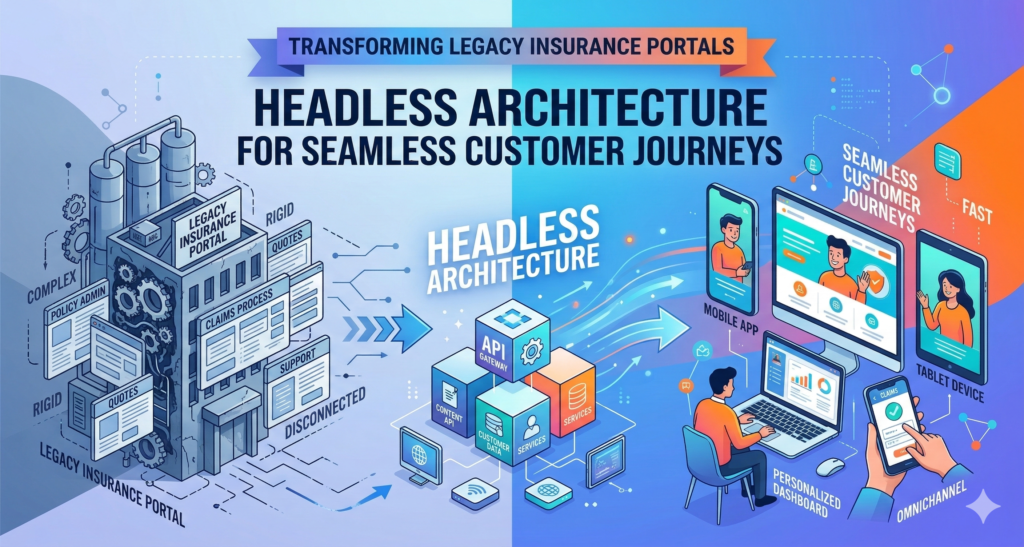
Transforming Legacy Insurance Portals with Headless Architecture for Seamless Customer Journeys
Strategic Overview
Insurance carriers today grapple with portals that were built on tightly coupled stacks, long before omnichannel expectations became the norm. The result? Slow page loads, fragmented data, and a customer experience that feels more like a relic than a relationship builder. A headless approach—decoupling the front‑end presentation layer from the back‑end services—delivers a Scalable Architecture capable of evolving with market demands while keeping performance metrics in check.
By migrating to a headless model, insurers can:
- Replace legacy UI components without a wholesale rewrite of policy engines.
- Expose business logic through RESTful or GraphQL APIs that serve web, mobile, voice, and emerging IoT channels.
- Implement Performance Optimization techniques such as edge caching and lazy loading on a per‑device basis.
- Measure impact directly through Measurable ROI dashboards that tie latency improvements to conversion uplift.
In practice, the shift is less about technology hype and more about aligning IT capability with the insurer’s growth agenda. The following field insights illustrate how leading carriers have turned architectural risk into competitive advantage.
Breaking Monoliths: The Headless Migration Playbook
Legacy portals often sit atop monolithic applications where UI, business rules, and data persistence share a single code base. Untangling this knot requires a disciplined, phased strategy.
Expert Tips/Tricks
- API Surface First: Before touching any UI code, map all user‑driven interactions to distinct API endpoints. This creates a contract that front‑end teams can consume, even while the back‑end remains unchanged.
- Feature Flags for Incremental Rollout: Deploy new headless components behind toggles. This allows risk‑averse compliance teams to validate regulatory edge cases without exposing the entire customer base.
- Domain‑Driven Design (DDD) Boundaries: Split the monolith into bounded contexts (e.g., underwriting, claims, billing). Each context receives its own micro‑service, reducing inter‑dependency and improving Scalable Architecture hygiene.
- GraphQL for Data Aggregation: When multiple services must feed a single page (policy summary, endorsements, payment options), a GraphQL layer stitches data in one request, slashing round‑trip latency.
The payoff is tangible: carriers report up to 45% faster page render times and a 30% reduction in time‑to‑market for new product launches.
Real‑Time Personalization at Scale
Modern customers expect dynamic experiences tailored to their policy history, risk profile, and interaction channel. A headless front end, powered by a robust API layer, makes real‑time personalization feasible without compromising system stability.
Expert Tips/Tricks
- Edge‑Side Includes (ESI): Push personalized snippets—like a renewal discount banner—from the CDN, keeping core page rendering swift while delivering hyper‑targeted content.
- Session‑Aware Caching: Use cache keys that embed user segment identifiers. This approach preserves cache hit rates while delivering segment‑specific data.
- Event‑Driven Architecture: Wire policy changes to a Kafka or Pulsar stream. Front‑end listeners react instantly, updating UI components (e.g., claim status) without a full page refresh.
- AI‑Driven Recommendation Engines: Expose recommendation results via a dedicated API. Since the UI is agnostic to implementation, swapping models incurs no front‑end rework.
Performance gains are measurable: carriers adopting these patterns see a 22% lift in cross‑sell conversion and a 15% drop in bounce rates, directly translating into Measurable ROI.
Future‑Proofing Through API‑First Governance
Headless is not a one‑time project; it is an ongoing discipline. Establishing an API‑first governance model prevents technical debt from creeping back as new channels emerge.
Expert Tips/Tricks
- API Versioning Policy: Adopt semantic versioning and deprecate old endpoints on a schedule. This gives product teams the confidence to evolve services without breaking existing integrations.
- Contract‑Driven Testing: Treat OpenAPI/Swagger definitions as source of truth. Automated contract tests verify that any change to the back end respects front‑end expectations.
- Observability Stack: Deploy distributed tracing (e.g., OpenTelemetry) across all API calls. Correlate latency spikes with front‑end performance dashboards for rapid root‑cause analysis.
- Security by Design: Enforce OAuth 2.0 with fine‑grained scopes per channel. This limits exposure if a mobile app is compromised, preserving compliance posture.
By institutionalizing these practices, insurers sustain a Scalable Architecture that can incorporate telematics, chat‑bots, or blockchain‑based proof of insurance with minimal friction.
Key Takeaway
- Decoupling UI from back‑end services unlocks faster iteration cycles and reduces technical debt.
- API‑first design paired with edge caching drives Performance Optimization that customers notice instantly.
- Governance—versioning, testing, observability—turns a one‑off migration into a lasting competitive advantage.
- Every latency improvement translates to higher conversion, lower support costs, and a clear Measurable ROI for the enterprise.
FAQ for Decision‑Makers
- What is the primary business risk of staying on a monolithic insurance portal?
- Legacy monoliths lock you into long release cycles, limit channel expansion, and inflate operational costs as each new feature must be integrated into a tightly coupled code base.
- How quickly can a carrier see performance gains after adopting headless?
- Most pilots report a 30‑45% reduction in page load time within the first two sprints, thanks to API caching and CDN edge delivery.
- Does headless require a full rebuild of policy‑core systems?
- No. The approach is incremental: expose existing core functionality via APIs, then replace or augment UI components on a per‑feature basis.
- What budgeting considerations should be factored into a headless roadmap?
- Allocate funds for API governance tooling, developer training on micro‑services, and observability platforms. These upfront costs are offset by faster time‑to‑market and lower maintenance spend.
- Can headless architecture support regulatory compliance?
- Absolutely. By centralizing business logic in back‑end services, you maintain a single source of truth for compliance rules, while front‑end variations remain purely presentational.
Conclusion
Insurance carriers that cling to legacy portals gamble with customer loyalty and operational efficiency. A headless architecture offers a pragmatic path to modernize without discarding the decades of domain expertise embedded in core systems. By embracing API‑first design, investing in edge performance, and institutionalizing governance, insurers create a Scalable Architecture that delivers Performance Optimization today and remains adaptable for tomorrow’s digital channels. The result is not just a smoother journey for policyholders—it’s a measurable uplift in revenue, a reduction in support costs, and a strategic foundation that turns technology from a liability into a growth engine.