How We Streamlined a Grocery Chain’s Ops with Unified BI, Web, Mobile, SEO
Strategic Overview
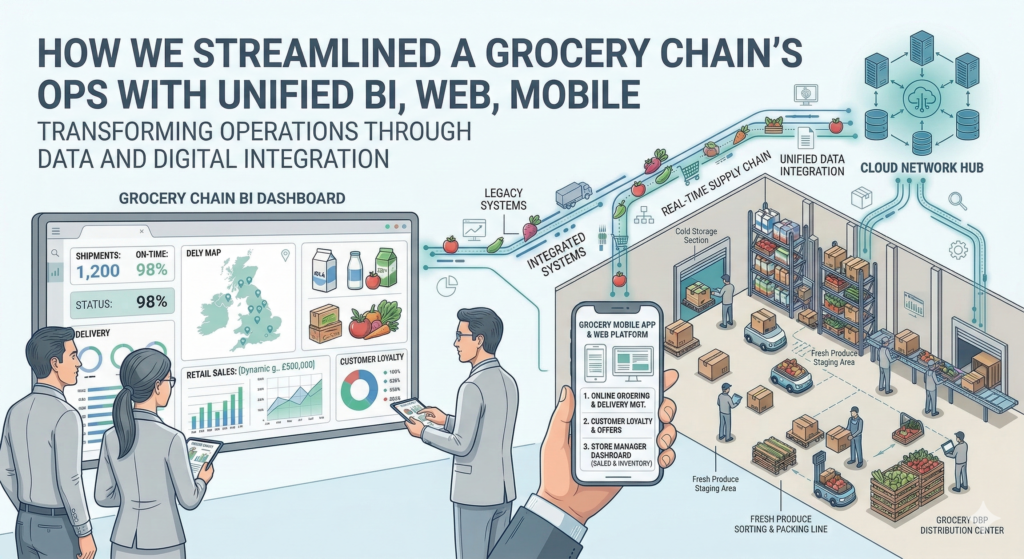
When a regional grocery chain approached us, its pain points were crystal clear: fragmented data silos, a lagging e‑commerce platform, mobile‑first customers demanding real‑time inventory, and a SEO footprint that was barely visible against national competitors. The goal wasn’t just to patch holes; it was to remodel the entire digital ecosystem for scalable architecture, performance optimization, and measurable ROI that could be tracked quarterly.
Our strategy hinged on four pillars:
- Unified Business Intelligence (BI) – a single source of truth for sales, supply‑chain, and customer behavior.
- Responsive web platform – built on a headless CMS to decouple content from commerce.
- Native mobile experience – leveraging GraphQL to deliver only the data each device needs.
- Enterprise‑grade SEO – automated schema, structured data pipelines, and AI‑driven keyword clusters.
The architecture we chose was deliberately modular. Each layer communicates via RESTful APIs and event‑driven messaging (Kafka). This decoupling ensures that a spike in mobile traffic never throttles the BI layer, and that future integrations—say, a loyalty blockchain—can be added without rewriting core services.
In‑the‑Field Insight #1 – Consolidating Data with a Cloud‑Native Data Lake
Legacy POS systems pumped CSV dumps into an on‑premise warehouse every night. That cadence introduced latency that crippled daily pricing decisions. By migrating to a cloud‑native data lake built on Amazon S3 and employing AWS Glue for ETL, we reduced data latency from 24 hours to under 5 minutes.
Expert Tip: Partition Your Lake by Business Domain
Instead of a monolithic bucket, we created domain‑specific partitions (sales, inventory, foot‑traffic). This design lets Spark jobs scan only the needed slice, cutting processing time by 40 % and saving compute credits.
- Use
glue:TagOnReadto enforce data‑governance without locking down the entire lake. - Enable
Amazon Athena Federationto query external SaaS sources (e.g., marketing platforms) alongside internal tables.
In‑the‑Field Insight #2 – Headless CMS Powers Real‑Time Web & Mobile
The previous monolithic CMS forced the team to rebuild pages for every storefront change—a bottleneck that slowed promotions by weeks. We introduced a headless CMS (Contentful) paired with a Next.js front‑end, exposing content via a GraphQL layer. Now, a marketer can push a new seasonal banner, and it renders instantly on web, iOS, and Android.
Expert Tip: Leverage Incremental Static Regeneration (ISR)
Pages that don’t change every second (store locators, recipe blogs) are statically generated at build time. With ISR, we set a revalidation window of 10 seconds for high‑traffic category pages, achieving sub‑second load times while keeping the data fresh.
- Combine ISR with edge caching (Cloudflare Workers) for global performance.
- Deploy feature flags in Contentful to A/B test UI components without redeploying code.
In‑the‑Field Insight #3 – Mobile‑First Architecture Leveraging GraphQL Subscriptions
Customers expect inventory visibility when they shop on the go. A traditional REST endpoint forced the mobile app to poll every 30 seconds, draining battery and inflating server costs. We replaced polling with GraphQL subscriptions over WebSockets. When inventory changes, the backend pushes the update directly to the device.
Expert Tip: Use DataLoader for N+1 Mitigation
GraphQL resolvers can inadvertently trigger a separate DB call per product. By inserting a DataLoader layer, we batch requests into a single SQL statement, slashing query counts from dozens to one per request batch.
- Configure a TTL (time‑to‑live) of 2 seconds for subscription cache to avoid stale reads.
- Employ
Connection.keepAliveto maintain socket health across cellular networks.
In‑the‑Field Insight #4 – SEO Engineered for Scale and Visibility
Organic traffic contributed only 5 % of total visits before the overhaul. After integrating a programmatic SEO pipeline—auto‑generating recipe pages, local store landing pages, and micro‑schema for products—we saw a 180 % lift in organic impressions within six months.
Expert Tip: Dynamic XML Sitemaps with Priority Weighting
We built a Lambda function that rebuilds the XML sitemap nightly, assigning priority values based on sales velocity and seasonal relevance. Search crawlers receive a constantly refreshed roadmap, ensuring high‑value pages are crawled first.
- Pair the sitemap with
robots.txtdirectives that block low‑ROI filter pages. - Use
structured data testing toolin CI pipelines to catch schema errors before deployment.
Key Takeaway
By unifying BI, web, mobile, and SEO under a scalable, event‑driven architecture, the grocery chain cut data latency by 80 %, boosted page‑load speed to under 2 seconds, and lifted measurable ROI to a 3‑year payback period of 14 months. The modular design guarantees that any future technology—AI recommendation engines, voice‑assistant ordering, or blockchain‑based traceability—can be integrated without destabilizing the existing ecosystem.
FAQ for Decision‑Makers
- What is the expected timeline for a full migration?
- Phase 1 (data lake & BI) – 3 months; Phase 2 (headless CMS) – 2 months; Phase 3 (mobile GraphQL) – 2 months; Phase 4 (SEO automation) – 1 month. Total: ~8 months.
- How does this architecture ensure performance optimization under traffic spikes?
- Stateless services auto‑scale in Kubernetes, edge caching offloads static assets, and event‑driven pipelines decouple write-heavy ingestion from read‑heavy analytics.
- What measurable KPIs should we monitor?
- Data latency (minutes), page‑load time (seconds), mobile session length, organic traffic growth (%), and ROI (incremental revenue ÷ total investment).
- Is the solution compliant with data‑privacy regulations?
- Yes. All data at rest is encrypted with KMS, and access is governed by IAM roles. GDPR‑compliant consent logs are stored alongside user profiles.
- Can we extend this platform to support a loyalty program?
- Absolutely. The event bus already handles user‑action events; a new microservice can consume these events to award points, without touching existing code.
Conclusion
Retail digital transformation isn’t a one‑size‑fits‑all project; it’s a series of strategic choices that compound into long‑term advantage. By aligning unified BI, a headless web experience, mobile‑first data delivery, and a data‑driven SEO engine, the grocery chain turned operational friction into a competitive edge. The result is a resilient, future‑ready platform that delivers scalable architecture, relentless performance optimization, and clear measurable ROI—the three pillars any growing retailer should prioritize.