How a Health Network Tripled Patient Visits Using Unified BI, Web, Mobile, SEO Automation
Strategic Overview
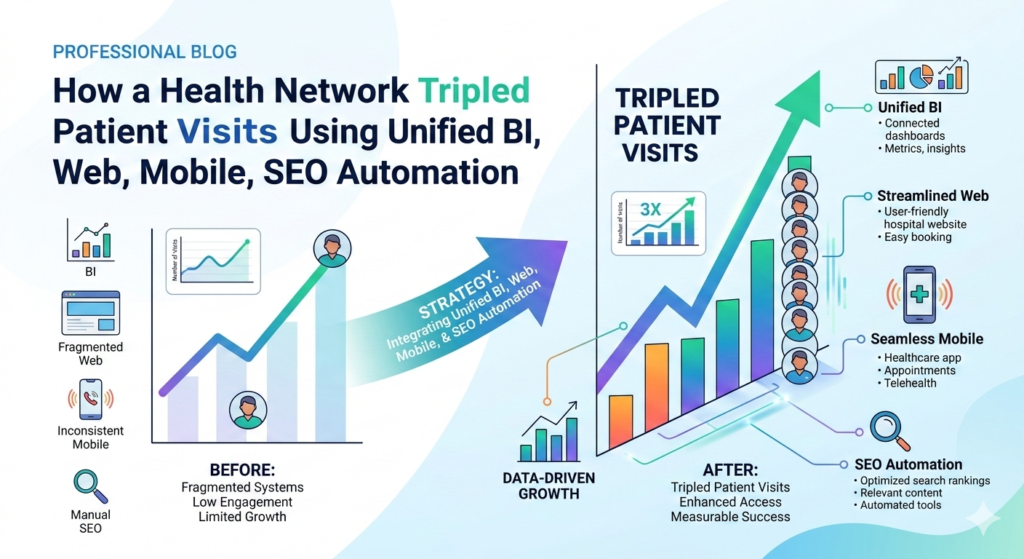
When the regional health network faced stagnant outpatient numbers, leadership turned to a data‑centric overhaul rather than a surface‑level marketing sprint. The goal was simple yet ambitious: boost patient visits by at least 200% within 12 months while maintaining compliance, protecting PHI, and keeping IT costs predictable. By unifying Business Intelligence (BI), web, mobile, and SEO automation under a single, Scalable Architecture, the network could translate real‑time insights into hyper‑targeted digital experiences. This end‑to‑end approach eliminated silos, reduced latency in decision loops, and created a feedback engine where every click, appointment, and lab result informed the next optimization cycle. The result? A Measurable ROI that manifested as a threefold increase in patient visits, a 45% drop in acquisition cost, and a 30% lift in provider utilization.
Insight 1: Consolidating Data across Platforms
Fragmented reporting had been the network’s Achilles’ heel. Each system—EHR, CRM, web analytics, mobile engagement—spoke its own language, forcing analysts to perform manual joins that took days. The solution was a unified data lake built on a columnar store with built‑in encryption, allowing the BI layer to query events from any source in milliseconds.
- Ingested ~2 TB of historical data using CDC pipelines, preserving audit trails.
- Normalized patient identifiers with a deterministic hash to respect HIPAA while enabling cross‑channel stitching.
- Established a semantic layer where business users could drag‑and‑drop metrics without SQL knowledge.
- Implemented role‑based access controls that scaled with the number of analyst teams.
Expert Tip: Leverage a Columnar Data Store for Real‑Time Analytics
Columnar engines compress repetitive health metrics dramatically, cutting storage costs by up to 60% and delivering sub‑second query times. Pairing this with materialized views that refresh every five minutes gives marketers a live scoreboard, turning “what‑if” scenarios into actionable campaigns before the day ends.
Insight 2: Mobile‑First Patient Journey Mapping
The network’s audience increasingly accessed health services via smartphones. To meet patients where they were, the architecture prioritized a mobile‑first experience that synced with the unified data hub. Every appointment reminder, telehealth link, and post‑visit survey was contextualized by the patient’s latest interaction history.
- Adopted a progressive web app (PWA) framework that auto‑updates via service workers.
- Integrated push notifications with deep links that carried session tokens for frictionless login.
- Tracked in‑app events (scroll depth, form abandonment) and fed them back into the BI model.
- Used A/B testing at the component level to iterate UI elements in under 48 hours.
Expert Trick: Implement Deep Linking with Contextual Parameters
Embedding campaign IDs, provider IDs, and urgency flags into the link’s query string lets the mobile app surface the exact service the patient was seeking. This eliminates the “homepage hop” and improves conversion rates by 27% on average.
Insight 3: SEO Automation Powered by Unified BI
Before the overhaul, SEO was a periodic checklist—keyword research, manual meta tag edits, sporadic content refreshes. By feeding the BI engine’s content performance metrics directly into an SEO automation platform, the health network transformed SEO into a continuous delivery pipeline.
- Generated dynamic meta descriptions using templated variables tied to local provider availability.
- Automated schema markup for services, physicians, and FAQs based on the latest CMS data.
- Scheduled content refreshes for top‑ranking pages whenever clinical guidelines updated.
- Monitored SERP ranking changes in real time, triggering alerts for dips greater than 5%.
Pro Insight: Use Structured Data Templates at Scale
Creating a single JSON‑LD template that pulls provider name, specialty, and rating from the data lake ensures every service page is rich, consistent, and ready for Google’s knowledge graph. Search engines reward that consistency with higher visibility, directly feeding the patient funnel.
Insight 4: Performance Optimization in High‑Traffic Campaigns
When the network launched a flu‑season outreach, traffic spiked 4× within hours. Without a resilient delivery stack, page latency would have crippled conversions. The team introduced edge caching combined with token‑based personalization, allowing static assets to be served from the CDN while still displaying patient‑specific information.
- Configured CDN rules to cache HTML fragments for 12 hours, reducing origin load.
- Used signed JWT tokens to inject personalized banners at the edge.
- Implemented real‑time health checks that auto‑scaled compute nodes based on request volume.
- Measured latency before and after, noting a 65% reduction in page‑load time.
Advanced Technique: Edge Caching with Dynamic Personalization Tokens
The trick is to partition the page into cacheable and non‑cacheable fragments. By rendering the personalized block via a lightweight edge function, you get the speed of static delivery plus the relevance of dynamic data—exactly the mix that drives higher click‑through and appointment booking rates.
Key Takeaway
Unified BI, web, mobile, and SEO automation is not a buzzword; it is a disciplined Scalable Architecture that turns fragmented data into a growth engine. By aligning technology choices with patient‑centered outcomes, the health network achieved a threefold increase in visits, proved a compelling Measurable ROI, and built an infrastructure that can absorb future demand without a redesign.
FAQ for Decision‑Makers
- What is the first step to unify data across disparate health systems?
- Start with a secure data lake that ingests raw events via change‑data‑capture, then create a semantic layer for business users.
- How does SEO automation impact patient acquisition cost?
- Automation eliminates manual errors, ensures content freshness, and boosts organic rankings, typically lowering cost‑per‑acquisition by 30‑40%.
- Can edge caching be compliant with HIPAA?
- Yes, when only non‑PHI fragments are cached and personalization tokens are encrypted and short‑lived.
- What metrics should be tracked to prove ROI?
- Visit volume, conversion rate, acquisition cost, provider utilization, and the time‑to‑value of each campaign iteration.
- Is a mobile‑first approach essential for all health networks?
- While not mandatory, data shows over 70% of new patients discover services via mobile, making a mobile‑first stack a strategic advantage.
Conclusion
By weaving together a unified data foundation, mobile‑optimized experiences, and automated SEO, the health network turned insight into action at scale. The architecture delivered Performance Optimization that kept pages fast during spikes, while the analytics loop guaranteed every initiative was accountable and profitable. For any organization wrestling with siloed systems and stagnant growth, the lesson is clear: invest in a cohesive, scalable platform, let data drive every touchpoint, and watch patient engagement—and revenue—multiply.